Today I decided to spend the morning at the hospital's public clinic, observing an internist in the women's open clinic. When I arrive at 7:45 or 8am, there is already a crowd of people lined up outside the receptionist office, and they don't start seeing patients until usually 8:30 or 9am. I don't know what time they start lining up outside, but it's certainly much earlier. Most of the patients seen here are indigenous and many don't speak Spanish, so they often come with several family members to help interpret. After they're signed in, a group of women are given thermometers to put under they're tongues and one by one they're temperatures are noted down before they go in to see the doctor.
Dr. Joanna Rogosh is the internist who sees patients on weekday mornings. She is from Poland and came to Xela during her travels more than a decade ago to go to Spanish school. She liked it so much that she decided to stay for a while. She had always been interested in medicine as a profession, so she decided to go to medical school here. She was in medical school for the full 6 years and in the meantime met a Guatemalan man and got married. She now has a 4 year old son, but has divorced her husband since, and has been practicing medicine for 4 years. Her father now lives in Germany and she has been talking about moving there soon with her son. From what I've observed of Dr. Rogosh with her patients, I'd say that she's an outstanding doctor by any standard. She listens intently to the gripes of the patients while also keeping them focused on one thing at a time. Patients will often just come in and list off all their aches and pains and the doctor has to stop them and ask about the nature and history of each complaint.
It's sometimes a whole other ballgame when seeing patients who only speak their indigenous language and almost no Spanish. One woman came in complaining that she had not had "orina grande (big urine)" in a few days and she is only able to go every few days. The doctor asked if she had urinated yet today. The patient said that she had "orina pequeña (small urine)" this morning, but has not had "orina grande" since a couple days ago. After many questions and much confusion, the doctor realized that when the patient said orina grande, she was actually referring to poop, and orina pequeña referred to pee. Whew, ok, so now we know the patient's constipated! Apparently in a prior lab test they also found that she had tested positive for Helicobacter pylori, which causes gastris and stomach ulcers.
In general, Guatemala's public health system is pretty good, considering that you can see a doctor and be admitted to the hospital at no personal cost. After admission, however, there are many things that the patient will have to pay for out of pocket. Usually the more routine diagnostic tests, such as routine hematology, xrays, echocardiograms, etc. are done free at the hospital, but if patients needs a CT scan, a MRI, or if the hospital's blood analysis machines happen to not be working that day, they must go to a private clinic where they have those resources. And at the private clinics you pay out of pocket. Then you can take the results back to hospital and continue your treatment there. Most medicines must also be paid for by patients, and when it may be an expensive antibiotic that they need, they often go without.
The last patient Dr. Rogosh saw before I left for the day was an older woman, maybe around 60 years old, that was going through chemotherapy for cervical cancer, which had spread to her bladder. Poor woman. Dr. Rogosh had obviously seen her many times before and was closely following her case. Today she complained of fever, nausea, and vomiting. She had a catheter coming out of her side, directly from the kidney, because she could no longer urinate normally. The bag that took the urine had a hole in it and the smell of stale, infected urine filled the exam room in seconds. They got her a new bag. Dr. Rogosh informed the woman and her family that she would admit her into the hospital right away to treat the infection, but that they don't have a strong enough antibiotic to treat her with and that she would have to go to the public hospital in Xela instead. The woman said that she had been there before for her infected catheter, but that she was not attended well. She said that just a couple of med students looked at it and sent her home, only to then return to this hospital a couple days later. Dr. Rogosh said that she would send a note with the woman to the hospital in Xela explaining the problem, but then on second thought she decided not to because then they may refuse to treat her because she had already been seen at this one. It sounds so insensitive, but the doctor said that is the way many public hospitals work. So Dr. Rogosh told the woman to go to the emergency room and from there the Xela hospital would have to admit and treat her. We could only hope that after the hour and a half bus ride to Xela the woman would indeed be admitted and not turned away once again for whatever reason.
Monday, September 27, 2010

Saturday, September 25, 2010
Mis primos chapines :-)
Today is Saturday, so no hospital or classes. I was going to go to a water park about an hour and a half or two hours away - in a warmer climate than Xela - but it started raining pretty hard which could cause more landslides, so we decided not to go. I had made plans to have dinner with Roberto's family. I think I mentioned them in a previous post; it's a little complicated, but Roberto is the brother of my dad's cousin's husband. So I just call them my cousins - mis primos chapines (chapin = Gutemalan, primos = cousins) - to simplify it.
At 7pm two of Roberto's kids, Ixquik and Tepeu, came to pick me up in front of the school. Roberto and Lesbia have 3 kids, all university age. Ixquik, the oldest daughter, is studying law, Maya is next and she's working but I can't remember in what, and Tepeu, the "baby boy" is in design school. They live in Zunil, which is not far from Xela, but they also have an apartment in Xela, which is where they took me for dinner. They welcomed me with open arms, had planned a beautiful dinner for me, and asked me a lot of questions about my trip so far and how my time was in Guatemala City. I felt guilty for not having contacted them earlier, I guess I didn't realize that they were actually waiting for my arrival.
The dinner was absolutely delicious. It was jocóm (sp?), which is a chicken dish with a green sauce made with cilantro, celery, and other good stuff, served with rice. When Lesbia offered me more I asked for just rice and sauce, but I guess she didn't hear me and gave me a whole serving more of chicken and rice! We also had this amazing sweet tea - Lesbia said it's Joseph's favorite, I know you're jealous, Joseph! - but I can't remember what the name of it is! Then after dinner we chatted and ate some of the chocolate I brought from Seattle from Theo Chocolates.
Ixquik is definitely the most outgoing of the kids. She asked me question after question, I almost felt like I couldn't finish answering one before she was on to another! Tepeu was the one I had first talked on the phone to, and he had been very nice and chatty. In person, though, he was so shy and soft-spoken, I couldn't believe it was the same person I had talked to on the phone. By the end of the night, it was just me and Ixquik left at the table. She helped me plan my two week trip around Guatemala after I'm done with classes here. She even looked up hotels that are near the bus stations I'll be going into in the various towns, and gave me their phone numbers. We'll be making plans to get together again, and I forgot to take pictures at this outing (oops!) but I will next time, don't worry Mom.
Friday, September 24, 2010
Cirugía
Today Cassandra and I decided to go to observe the cirugías (surgeries) at the hospital. First we had grand rounds in the auditorium, then they served everyone sweet coffee and tamales for breakfast. Yum. We chatted with Dr. Medina, the sub-director of the hospital who is kind of crazy and known for his antics among students and staff at the hospital. He introduced us to Dr. Aragon (Carlos), who would be doing the pedriatric surgeries for the day.
First up was a postectomía, which is the medical term for circumcision. It was on a 2 year old little boy that was getting chronic infections in his penis because the foreskin was very tight. Compared to what I've seen and described to you in the rest of the hospital, the surgeries are very clean and efficient. I didn't see any monitoring equipment there either, but there is a respirator and the anesthesiologist is constantly observing the patient and taking blood pressure readings. I realized that I never really had a clear picture in my head of what a circumcision procedure actually looks like until now, how the foreskin is cut, how much is cut off, and what they suture. It was a good thing they did it on this kid because when they pulled the foreskin back there was quite a bit of pus in there.
Next up was supposed to be a surgery on a boy to drop his retained testicle, but an emergency came in before they got started on it. The emergency was an older man, he appeared to be about 70 years old, who had gotten into some kind of accident with or in a pick up truck, resulting in his left forearm getting filleted open from pinky to elbow. Pretty gruesome. Luckily he had no broken bones, torn tendons, or damaged nerves or vessels in the arm, but the hand was a little more cut up. That surgery took a while so in the meantime we chatted with Carlos, the surgeon we were following, who was just waiting for the other surgeon to finish with the arm so he could do the testicular retention surgery. We asked about his life and found out that he plays volleyball and basketball 5 days a week or more, he lives alone, has never married, and has 3 kids with 3 different mothers. At this last divulgence he turned away in embarrassment, so we quickly changed the subject back to sports. I was able to take a lot of pictures with the doctors and students and we all exchanged emails to share them. Cassandra and I had already received an email from Carlos by that same afternoon!
Since the arm surgery was taking a while, Cassandra and I decided to observe a C-section instead before we had to leave. They have a operating room reserved exclusively for C-sections because they have so many. The mother was over 9 months along and the baby still hadn't even dropped down closer to the pelvis, so they decided to operate. The surgeon made a vertical cut in the abdomen and then a horizontal cut in the uterus. They had pull pretty hard at the opening and pushed on the upper abdomen to get the baby's head out. Once the baby boy was out we followed him into the next room where they did all the post-birth stuff, cleaned him, weighed him, gave vitamin K injection, etc. while the mother was being sutured up. It was so beautiful, I'm thinking maybe I'll go into obstetrics!!

 |
| Cassandra and I with coffee and tamalitos |

 |
| With Dr. Aragon |
 |
| With other med students |
Next up was supposed to be a surgery on a boy to drop his retained testicle, but an emergency came in before they got started on it. The emergency was an older man, he appeared to be about 70 years old, who had gotten into some kind of accident with or in a pick up truck, resulting in his left forearm getting filleted open from pinky to elbow. Pretty gruesome. Luckily he had no broken bones, torn tendons, or damaged nerves or vessels in the arm, but the hand was a little more cut up. That surgery took a while so in the meantime we chatted with Carlos, the surgeon we were following, who was just waiting for the other surgeon to finish with the arm so he could do the testicular retention surgery. We asked about his life and found out that he plays volleyball and basketball 5 days a week or more, he lives alone, has never married, and has 3 kids with 3 different mothers. At this last divulgence he turned away in embarrassment, so we quickly changed the subject back to sports. I was able to take a lot of pictures with the doctors and students and we all exchanged emails to share them. Cassandra and I had already received an email from Carlos by that same afternoon!
Since the arm surgery was taking a while, Cassandra and I decided to observe a C-section instead before we had to leave. They have a operating room reserved exclusively for C-sections because they have so many. The mother was over 9 months along and the baby still hadn't even dropped down closer to the pelvis, so they decided to operate. The surgeon made a vertical cut in the abdomen and then a horizontal cut in the uterus. They had pull pretty hard at the opening and pushed on the upper abdomen to get the baby's head out. Once the baby boy was out we followed him into the next room where they did all the post-birth stuff, cleaned him, weighed him, gave vitamin K injection, etc. while the mother was being sutured up. It was so beautiful, I'm thinking maybe I'll go into obstetrics!!

Monday, September 20, 2010
La Manifestación
Today was another hospital day and this time more students decided to come. Cassandra (from near Portland, OR), Liz (from Philly), Josh (Denver) and I met up in front of the school at 6:30am to walk to the bus stop. As always, we took a microbus to the rotonda to catch the big bus to Totonicapán. When we got on the bus they only charged us 3.00 quetzales each instead of the usual 5.50Q. I didn't think too much of it, I thought maybe it was our lucky day. As it turned out, quite the opposite.
We arrived about 30 mins down the road at Cuatro Caminos (Four Roads) where the bus stopped, turned around, and turned off the engine. The driver said we had to get out, cross the street, and walk "como cinco cuadras (like five blocks)," to catch another bus, with no further explanation. So we did that, along with everyone else getting off the buses. We were confused as to why this stretch of road was closed off, so I asked a man on the side of the road. At first he just repeated that we had to walk to get to transportation, but this time it was 3 or 4 kilometers. Finally he told us that it was because there was a manifestación, a protest, that the road was closed off, but that if we walked past Las Cruces, where the protest was being held, we should be able to find transportation to Toto.
It was probably a kilometer before we reached Las Cruces. There was a stage with large speakers where the protest leaders were giving speeches. The people there were mostly farmers and indigenous people who were protesting the high cost of electricity. Apparently, in that area households are paying an outrageous amount for enough electricity to light only a bulb or two, stemming from last year's very low rainfall. Even after this year's record-breaking rains, they're still paying the higher cost. There was such an energy there by the stage, with people holding signs and vendors taking advantage of the large gathering to sell food and hot drinks on that foggy morning. It was encouraging to see that the people here really try to organize and fight for their rights rather than remaining apathetic toward injustice, which would be easy to do when you feel ignored by your government.

Cuatro caminos is a very important section of the highway because all transport goes through there to reach different towns and cities in the region - trucks carrying goods to market, buses with travelers, commuters, etc. Seems like the protesters have a clever strategy, but it's not the government or the electric company that ends up suffering the most, it's the regular people who are just trying to make a living.
We continued walking down the road toward Toto, expecting to be able to catch some kind of bus along the way. We definitely saw a lot of buses, but they were all stopped and empty along the side of the road. Occasionally we'd get passed by a pickup full of people. After maybe an hour and a half of walking we decided this was a fruitless journey, and even if we did make it to the hospital, we'd have to leave almost immediately to make it back to school in time for classes. So we turned around and walked all the way back to where the bus had dropped us off.......but the buses were gone. The protesters had extended the road block even further down the road, which added about another 30 mins to our walk. Finally we got a bus and made it back home at about 11:30am. Enough time to take a little nap and have lunch before class.
I talked to my host mother, Marta, about the manifestación and she said that Guatemala is a country of many protests, but with little results. There were two other protests around Xela just this week, one for children's education, and one for access to healthcare and medicine.
We arrived about 30 mins down the road at Cuatro Caminos (Four Roads) where the bus stopped, turned around, and turned off the engine. The driver said we had to get out, cross the street, and walk "como cinco cuadras (like five blocks)," to catch another bus, with no further explanation. So we did that, along with everyone else getting off the buses. We were confused as to why this stretch of road was closed off, so I asked a man on the side of the road. At first he just repeated that we had to walk to get to transportation, but this time it was 3 or 4 kilometers. Finally he told us that it was because there was a manifestación, a protest, that the road was closed off, but that if we walked past Las Cruces, where the protest was being held, we should be able to find transportation to Toto.
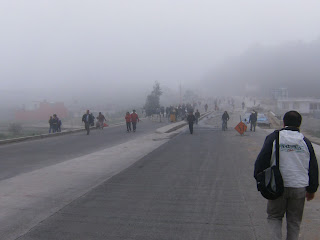 |
| Walking toward the protest at about 7am |
It was probably a kilometer before we reached Las Cruces. There was a stage with large speakers where the protest leaders were giving speeches. The people there were mostly farmers and indigenous people who were protesting the high cost of electricity. Apparently, in that area households are paying an outrageous amount for enough electricity to light only a bulb or two, stemming from last year's very low rainfall. Even after this year's record-breaking rains, they're still paying the higher cost. There was such an energy there by the stage, with people holding signs and vendors taking advantage of the large gathering to sell food and hot drinks on that foggy morning. It was encouraging to see that the people here really try to organize and fight for their rights rather than remaining apathetic toward injustice, which would be easy to do when you feel ignored by your government.

 |
| The protest at Cuatro Caminos |
Cuatro caminos is a very important section of the highway because all transport goes through there to reach different towns and cities in the region - trucks carrying goods to market, buses with travelers, commuters, etc. Seems like the protesters have a clever strategy, but it's not the government or the electric company that ends up suffering the most, it's the regular people who are just trying to make a living.
We continued walking down the road toward Toto, expecting to be able to catch some kind of bus along the way. We definitely saw a lot of buses, but they were all stopped and empty along the side of the road. Occasionally we'd get passed by a pickup full of people. After maybe an hour and a half of walking we decided this was a fruitless journey, and even if we did make it to the hospital, we'd have to leave almost immediately to make it back to school in time for classes. So we turned around and walked all the way back to where the bus had dropped us off.......but the buses were gone. The protesters had extended the road block even further down the road, which added about another 30 mins to our walk. Finally we got a bus and made it back home at about 11:30am. Enough time to take a little nap and have lunch before class.
 |
| Right before we gave up and started walking back |
I talked to my host mother, Marta, about the manifestación and she said that Guatemala is a country of many protests, but with little results. There were two other protests around Xela just this week, one for children's education, and one for access to healthcare and medicine.
Saturday, September 18, 2010
El Volcán Santa María
Today is the day I reached the top of the world. Or at least as close as I'm going to get to it.
We met at the school at 4:30am and our guide, Martín, drove us in a van to the base of the Santa María volcano. A few of us from Miguel Angel Asturias went, as well as about 10 other people from other English schools in Xela. Last weekend I went for a bike ride to a neighboring pueblo with a guide and two of the other students I went with also came on the volcano hike. We started hiking just after 5am. About 20 mins into the hike one of my classmates started getting so dizzy that she couldn't walk straight. This was before we had climbed any significant vertical amount, so Martín was going to take her back to Xela.
In the meantime, we continued with the other guide. The first part was relatively tame, we basically walked in a little creek bed - that is only a real creek when there are heavy rains, like there were 2 weeks before - until we made it to la meseta, a flatter, grassy area before we start climbing the actual cone of the volcano.
Xela is at about 7,700 ft and the top of Santa María is at 12,375 ft. If I do my math right, that's more than 4,600 vertical feet of climb. And it sure felt like it! From the meseta the cone didn't look all that imposing, as another student pointed out, but of course, that was enough to jinx it. It was a steep climb from there with lots of switch backs. Every time I though we were getting close, the guide would say, "Oh, not much more, maybe another 2 hours or so." As we got closer to the top we started spreading out more because some people, like myself, were more affected by the elevation and had to stop more often to recover. At one point I was going at about the same speed as a group of 4 indigenous women, representing 3 generations. They said the they hadn't had anything to eat or drink since the night before because it's better to make the climb on an empty stomach. I had already had a cinnamon roll for breakfast, which in hindsight was probably not the best choice. I didn't feel quite as out of shape seeing that the women had to stop almost as often as I did to catch their breath. However, they were climbing in foam flip flops with their lunch wrapped in cloth on their backs. And they do this climb very often.
As I neared the top of the volcano I started getting nauseous. I would catch my breath just fine when I stopped to rest but then once I started moving again I felt like I had to rest every 10 steps. I finally got there at 9:40am. I sat with a group of students who had already arrived and tried to eat some of the bread and peanut butter I have brought. I didn't get far into the food before I had to stick my head behind a rock and vomit up everything I had eaten that day. I felt a little better after that, but still like I couldn't fully enjoy the view and the experience of being there, which was truly amazing. I laid down on one of the many huge boulders and took a 40 min nap in the sun. It was cold enough to need a fleece and jacket over it, but in the sun it was perfect. After I woke up I was finally able to look around and appreciate where I was. We could see every little town and the clouds were racing by just below us. Groups of people in their indigenous dress were doing their prayer rituals mixing Spanish, Quiché, Christianity, and indigenous rituals. Some people climb the volcano to pray every weekend.


At 11am we started the descent, which was much more pleasant. Usually my knees and hips start bothering me when I go down, but this time I felt fine the whole time. We reached the vans around 2pm. I thought I was going to be so sore after such a hike, also because I haven't been doing any significant amount of exercise recently, but I actually felt great the next day.
The girl that had gotten dizzy at the very beginning of the hike had actually continued after sitting for about 30 mins. I couldn't believe she still wanted to keep going after getting so dizzy fromt he very beginning! She was pretty hardcore. We ran into her on the way down the volcano, she made to within about 20 mins of the top, but never actually made it there. Later that day she said she had really wanted to get to the top and asked if anyone would do it with her the next day. Seriously? The next day?! Maybe in a couple weeks.
We met at the school at 4:30am and our guide, Martín, drove us in a van to the base of the Santa María volcano. A few of us from Miguel Angel Asturias went, as well as about 10 other people from other English schools in Xela. Last weekend I went for a bike ride to a neighboring pueblo with a guide and two of the other students I went with also came on the volcano hike. We started hiking just after 5am. About 20 mins into the hike one of my classmates started getting so dizzy that she couldn't walk straight. This was before we had climbed any significant vertical amount, so Martín was going to take her back to Xela.
In the meantime, we continued with the other guide. The first part was relatively tame, we basically walked in a little creek bed - that is only a real creek when there are heavy rains, like there were 2 weeks before - until we made it to la meseta, a flatter, grassy area before we start climbing the actual cone of the volcano.
 |
| View of cone of volcano from la meseta |
Xela is at about 7,700 ft and the top of Santa María is at 12,375 ft. If I do my math right, that's more than 4,600 vertical feet of climb. And it sure felt like it! From the meseta the cone didn't look all that imposing, as another student pointed out, but of course, that was enough to jinx it. It was a steep climb from there with lots of switch backs. Every time I though we were getting close, the guide would say, "Oh, not much more, maybe another 2 hours or so." As we got closer to the top we started spreading out more because some people, like myself, were more affected by the elevation and had to stop more often to recover. At one point I was going at about the same speed as a group of 4 indigenous women, representing 3 generations. They said the they hadn't had anything to eat or drink since the night before because it's better to make the climb on an empty stomach. I had already had a cinnamon roll for breakfast, which in hindsight was probably not the best choice. I didn't feel quite as out of shape seeing that the women had to stop almost as often as I did to catch their breath. However, they were climbing in foam flip flops with their lunch wrapped in cloth on their backs. And they do this climb very often.
As I neared the top of the volcano I started getting nauseous. I would catch my breath just fine when I stopped to rest but then once I started moving again I felt like I had to rest every 10 steps. I finally got there at 9:40am. I sat with a group of students who had already arrived and tried to eat some of the bread and peanut butter I have brought. I didn't get far into the food before I had to stick my head behind a rock and vomit up everything I had eaten that day. I felt a little better after that, but still like I couldn't fully enjoy the view and the experience of being there, which was truly amazing. I laid down on one of the many huge boulders and took a 40 min nap in the sun. It was cold enough to need a fleece and jacket over it, but in the sun it was perfect. After I woke up I was finally able to look around and appreciate where I was. We could see every little town and the clouds were racing by just below us. Groups of people in their indigenous dress were doing their prayer rituals mixing Spanish, Quiché, Christianity, and indigenous rituals. Some people climb the volcano to pray every weekend.


 |
| View from the top |
At 11am we started the descent, which was much more pleasant. Usually my knees and hips start bothering me when I go down, but this time I felt fine the whole time. We reached the vans around 2pm. I thought I was going to be so sore after such a hike, also because I haven't been doing any significant amount of exercise recently, but I actually felt great the next day.
The girl that had gotten dizzy at the very beginning of the hike had actually continued after sitting for about 30 mins. I couldn't believe she still wanted to keep going after getting so dizzy fromt he very beginning! She was pretty hardcore. We ran into her on the way down the volcano, she made to within about 20 mins of the top, but never actually made it there. Later that day she said she had really wanted to get to the top and asked if anyone would do it with her the next day. Seriously? The next day?! Maybe in a couple weeks.
Friday, September 17, 2010
Disturbing incident in cuidado intensivo
Every Friday at the hospital, all the med students doing their rotation there gather in the auditorium for announcements and a guest speaker. Today it was actually a very inspirational speaker. I don't remember his name, but he was a very experienced M.D. who also did some family counseling. It was more of a motivational speech about how our (the med students') attitude toward work and their personal life will dictate how well we do and how much we can achieve in both those realms. These were all ideas I've heard before, but for some reason it touched me differently, perhaps because it was in Spanish, with different metaphors and different ways of explaining things. One line that I particularly liked was, "No es responsable por la cara que tiene, pero sí es responsable por la cara que me pone." Translation: "You're not responsible for the face that you have, but you are responsible for the face that you give me."
After the speaker, I went on rounds in the men's ward, then up to cuidado intensivo de recién nacidos, where I had been the whole week. They had already started rounds with the doctora, and were huddled around a baby in the corner, discussing that case. I joined them for a minute, then went around to look at the patients, seeing who was still there and who had gone home. I stopped at a little baby boy, one who I had seen on my first day, the preemie that was born at 34 weeks gestation. He was under a phototherapy light for his jaundice and had his eyes covered with a little blindfold. As I looked closer, I thought I was hallucinating that his chest wasn't moving. Sometimes premature babies will "forget" to breath for a few seconds, then usually start up again. I waited, still no movement. I couldn't tell what color the baby was because of the bright blue light he was under, but as I looked closer, it didn't look normal. As I took all this in, it didn't register right away and it was hard for me to believe that no one else had looked at this baby earlier (they are supposed to do their physical exam right before rounds) or noticed that anything was out of the ordinary. My heart was pounding. Was this really happening? Am I overlooking some obvious sign that he's really OK? I had to tell someone, so I called a student over, he opened the incubator, listened to the baby and called the doctor over immediately. She felt and listened to the baby, and almost right away said he was dead. At this point it was a little hard for me to understand what she was saying because she was both talking to herself and yelling at the students, but I assumed that he had been dead a while because there were no attempts made to resuscitate him. The doctor proceeded to lecture the students that it appeared that the baby hadn't even been looked at before rounds, when the physical exam was supposed to be done. Afterward, we went on to the next patient and nothing further was said about it. At that point I decided that I'm never going to have a baby or have any kind of health problems near this hospital, nor will any of my loved ones.
It occurred to me how easily something like this could happen in the cuidado intensivo here. There are no monitors on the babies to read their heart rate or oxygen levels, so if a premature baby stops breathing, which can happen very often, there is nothing to alarm the staff about it. The doctor and students are usually busy with rounds and paperwork, and there are only 2 nurses staffed for up to 17 babies. Obviously the treatment the babies are getting is better than nothing at all, but it just scares me how easily a baby in trouble can be overlooked until it's too late.
Thursday, September 16, 2010
Mole de plátano
Today I went to Daniela's host family's house and her mother, Sylvia, taught us how to make mole de plátano. It's somewhat similar to the Mexican chocolate, spicy mole that they put on enchiladas and chicken, but this one is a little sweeter and goes on fried plantains....mmmm.....
If you're really nice to me I'll make some for you. :-)
If you're really nice to me I'll make some for you. :-)
Subscribe to:
Posts (Atom)